Go back
Responding to evidence: the cOAlition S Strategy 2026–2030 explained
22/10/2026
By Curt Rice, Director of cOAlition S
Scientific progress depends on researchers being able to build on each other’s work. That simple idea has guided cOAlition S from the beginning, and it continues to guide us today.
Immediate access to research has become an expectation across much of the global research system, and that represents genuine progress. But ensuring access is only part of the challenge. If research is to fulfil its promise, the systems through which knowledge is shared must also be sustainable, equitable, and capable of adapting as science itself evolves.
I came to cOAlition S after many years working in research and university leadership. Throughout that work, I have been interested in the structures surrounding research: how policies and institutions shape what research gets done, how knowledge is shared and what kinds of careers researchers can build. In my first months as Director, I have been struck by how clearly the questions surrounding open access connect to those larger questions. Scholarly communication is not simply about where research is published. It is part of the system that shapes how research itself develops.
Nearly a decade has passed since the launch of Plan S. During that time, we have learned a great deal. Open access has moved from aspiration to reality for a growing share of the world’s research. At the same time, experience has revealed new challenges: cost pressures, uneven opportunities to participate, and rapid technological change. Artificial intelligence, in particular, is raising new questions about how research is discovered, used and reused.
“Ensuring access to research is only part of the challenge. If research is to fulfil its promise, the systems through which knowledge is shared must also be sustainable, equitable, and capable of adapting as science itself evolves.”
Our strategy is grounded in that experience, and it reflects much of what I have heard in my first conversations with members and partners. Our core conviction remains the same: publicly funded research should be immediately available for others to read, use and take further. But we now know more about what it takes to realise that ambition.
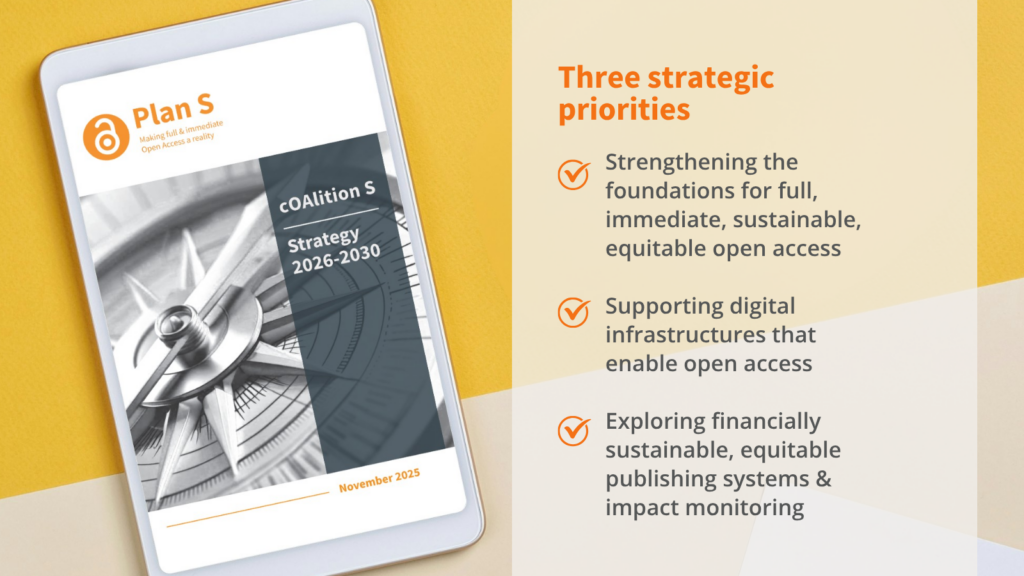
Responding to evidence is what researchers do. I believe it should also be what research supporting and research funding organisations do. As our understanding improves, our strategies should evolve. The priorities of the cOAlition S Strategy for 2026–2030 reflect that evolution.
- More routes to the same destination
Our first priority is to strengthen the foundations for full, immediate, sustainable and equitable open access. That includes updating our principles and learning more about the different routes through which those ambitions can be realised, including diamond open access, preprints and Publish-Review-Curate models.
- The infrastructure beneath the policy
Our second priority recognises that policies depend on the infrastructure beneath them. Sustainable, interoperable and community-governed infrastructure is essential to an open scholarly communication system. This is also where questions surrounding artificial intelligence, copyright and reuse increasingly demand attention.
- The economics of openness
Our third priority turns to the economics of the system. We want to understand which financial models can provide open access sustainably and equitably, and to improve our ability to monitor whether policies are producing the outcomes we intend.
This next phase of our work is therefore not about identifying a single route to an open access system. Our partners work in different research systems and policy environments, and they bring different perspectives and experiences to our shared objectives. That diversity gives us an opportunity to learn from different approaches while continuing to work towards common goals.
cOAlition S was built on the idea that funders can accomplish more by working together, and that remains fundamental to our approach. We want to understand what is working, where obstacles remain, and what funders can do individually and collectively to create a scholarly communication system that better supports the production and sharing of knowledge.
“Our core conviction remains the same: publicly funded research should be immediately available for others to read, use and take further.”
Over the coming months, we will publish our updated principles. Alongside these, we will be using this blog to explore the thinking behind our work through the voices of our partners and others in the cOAlition S community, and through my own. We will look more closely at the changing landscape of scholarly communication, the opportunities created by different publishing models, the role of open infrastructure, and the implications of artificial intelligence.
Science advances by questioning assumptions, testing ideas and learning from experience. The same principle should guide the systems that support science.
Our strategy reflects what we have learned so far and our determination to keep learning, adapting and moving forward together with our partners. I also look forward to continuing to learn from our colleagues and partners inside and beyond cOAlition S, and from the conversations this work will generate. I hope you will be part of them!
Curt Rice
Curt Rice is the Director of cOAlition S, working with research funders to advance a more open and equitable global system for scientific communication. He is a Norwegian academic leader whose work has focused on universities, research systems, open access, and the public role of knowledge institutions. Before joining cOAltion S, he served as Rector of Oslo Metropolitan University (OsloMet) and the Norwegian University of Life Sciences (NMBU), Executive Director of Fulbright Norway, and earlier as Vice Rector for Research at UiT The Arctic University of Norway. He also served as the founding director of the Centre for Advanced Study in Theoretical Linguistics (CASTL), a Norwegian Centre of Excellence. Contact info: curt.rice [at] coalition-s [dot] org
View all posts by
Curt Rice